Volume 13, Issue 4 (Autumn 2025)
Iran J Health Sci 2025, 13(4): 261-266 |
Back to browse issues page



Ethics code: XU REC Package No. NSG-2024001293
Clinical trials code: N/A


Download citation:
BibTeX | RIS | EndNote | Medlars | ProCite | Reference Manager | RefWorks
Send citation to:


BibTeX | RIS | EndNote | Medlars | ProCite | Reference Manager | RefWorks
Send citation to:
Paduit S C Y, Payopanin C F S, Piloton Z A C, Porras K H A, Sidic A D, Soler S J T, et al . Assessing First Aid Knowledge Among Non-medical Freshmen: Implications for Educational Training Programs. Iran J Health Sci 2025; 13 (4) :261-266
URL: http://jhs.mazums.ac.ir/article-1-1002-en.html
URL: http://jhs.mazums.ac.ir/article-1-1002-en.html
Samantha Celine Y. Paduit 
 , Celine Franscisca S. Payopanin , Zean Ansel C. Piloton , Krystelle Heart A. Porras , Ammarah D. Sidic , Sydney James T. Soler , Sherry Levita Swanenberg , Elizabeth Julia P. Tayag , Kaye Dominique Teves , Christian Dale P. Yasay , Paolo B. Araune *
  , Ivy R. Go
, Celine Franscisca S. Payopanin , Zean Ansel C. Piloton , Krystelle Heart A. Porras , Ammarah D. Sidic , Sydney James T. Soler , Sherry Levita Swanenberg , Elizabeth Julia P. Tayag , Kaye Dominique Teves , Christian Dale P. Yasay , Paolo B. Araune * , Ivy R. Go
Department of Mathematics, College of Arts and Sciences, Xavier University-Ateneo de Cagayan, Cagayan de Oro, Philippines. , paraune@xu.edu.ph
Full-Text [PDF 565 kb]
(578 Downloads)
| Abstract (HTML) (1883 Views)
Full-Text: (483 Views)
Introduction
First aid plays a vital role in emergency preparedness, equipping individuals with the ability to provide immediate and temporary care to those experiencing sudden illness or injury [1]. Its timely application can stabilize victims and prevent further harm until professional medical help arrives [1]. However, even in situations where first aid could make a critical difference, fear, lack of confidence, and insufficient knowledge often prevent bystanders from acting [2].
In non-clinical settings, such as homes, where healthcare professionals are typically absent, the competence of laypersons becomes particularly vital. Home accidents, for example, account for a significant proportion of childhood injuries worldwide, with immediate responders often being family members, such as mothers or siblings [3].
Recognizing the value of early intervention, the Philippine government enacted Republic Act No. 10871, or the Basic Life Support Training in Schools Act, requiring all primary and secondary schools to provide age-appropriate training in life-saving skills [4]. Complementing this, the good samaritan act aims to encourage bystander assistance by limiting legal liabilities. However, while designed to empower, such legislation may inadvertently reinforce the perception that only trained medical personnel or students are responsible for first aid delivery—potentially discouraging untrained individuals from intervening [5].
Despite these national initiatives, limited research has examined the first aid knowledge of non-medical college students, a large yet underutilized segment in community emergency preparedness. By assessing the level of first aid knowledge among selected non-medical first-year students in a tertiary university, this study aimed to identify knowledge gaps and highlight opportunities for integrating more inclusive, skills-based first aid training into educational programs. The findings can inform strategies that strengthen students’ confidence and capacity to act during emergencies, ultimately improving community resilience.
Materials and Methods
Research design
This study utilized a descriptive, cross-sectional design to assess first aid knowledge among selected non-medical first-year students. As noted by aggarwal and ranganathan [6], such a design is used to document characteristics and perceptions without manipulating variables.
Sample, sample size, and sampling technique
The respondents were non-medical freshmen officially enrolled in three college programs. Inclusion criteria encompassed first-year students aged 18 and above, regardless of prior participation in basic first aid seminars, workshops, or training within the past year, and regardless of whether they had rendered first aid. Students from medical-related programs, such as those enrolled in the School of Medicine and the College of Nursing, as well as upper-year students beyond the first year, were excluded.
Stratified random sampling was employed by dividing the total population of 544 students—obtained from official enrollment records provided by the deans—into three strata based on their college programs: The School of education, the school of business and management, and the college of engineering. Within each stratum, a list of eligible students was compiled, and simple random sampling using a random number generator was conducted to ensure equal representation and minimize selection bias.
The sample size was computed using cochran’s formula for finite populations, with the parameters set at a 95% confidence level, a 5% margin of error, and an assumed population proportion (p) of 0.5 to ensure maximum variability. This resulted in a required sample of 369 respondents, proportionally allocated as follows: 103 from the School of Education, 143 from the School of Business and Management, and 123 from the College of Engineering.
Data collection process
The data collection process began with a formal meeting between the researchers and the Deans of the three colleges to introduce the study and secure institutional approval. Coordination with class advisers and block representatives followed to facilitate the distribution of the online questionnaire. The survey link, accessible via a QR code, was sent to eligible students who voluntarily consented to participate. A cover letter accompanied the questionnaire, outlining the study’s objectives, assuring confidentiality, and emphasizing the voluntary nature of participation.
The online survey was available for one week. All responses were collected through Google Forms and securely backed up in password-protected Excel files, in accordance with the Data Privacy Act of 2012. No incentives were provided, and participants retained the right to withdraw at any time.
Instrument
A researcher-developed questionnaire was used to gather relevant data. It consisted of 30 items grouped into four sections: (1) demographic information (age, sex, and college program), (2) prior training or attendance in basic first aid seminars, (3) experience in providing first aid, and (4) knowledge-based items covering wound care, bleeding control, burns, and choking management. Knowledge items were measured using a 4-point Likert scale (1=strongly disagree to 4=strongly agree) to assess perceived knowledge and confidence in basic first aid.
To ensure validity, the questionnaire underwent face and content validation by three clinical instructors and certified first aid trainers from the College of Nursing. They reviewed the instrument for relevance, clarity, and coverage. Construct validity was established by aligning the items with first aid guidelines from the Philippine Red Cross and the American Heart Association. A pilot test was conducted with 30 non-participating students from similar programs, and the instrument was revised accordingly for clarity.
Reliability testing yielded a Cronbach’s α of 0.81 for the knowledge section, indicating good internal consistency. Knowledge scores were interpreted using predefined cut-offs to categorize overall knowledge as poor, fair, good, or excellent.
Data analysis
The knowledge scores were computed by summing the responses from the knowledge of basic first aid section, which used a 4-point Likert scale (1=strongly disagree to 4=strongly agree). Higher total scores indicated greater perceived knowledge of first aid practices. These scores were then classified into four categories—poor, fair, good, and excellent—based on predefined cut-off ranges established during pilot testing and literature review.
To determine whether there were statistically significant differences in knowledge scores based on demographic and training-related variables, the researchers used independent samples t-tests (for comparisons between the two groups) and one-way ANOVA (for comparisons among the three or more groups). Prior to conducting these parametric tests, assumptions of normality and homogeneity of variances were tested. Normality was assessed using the Shapiro-Wilk test and visual inspection of histograms and Q-Q plots, while Levene’s test was used to assess homogeneity of variances. A 95% confidence level and a significance threshold of P<0.05 were used to determine statistical significance.
Results
Bottom of form
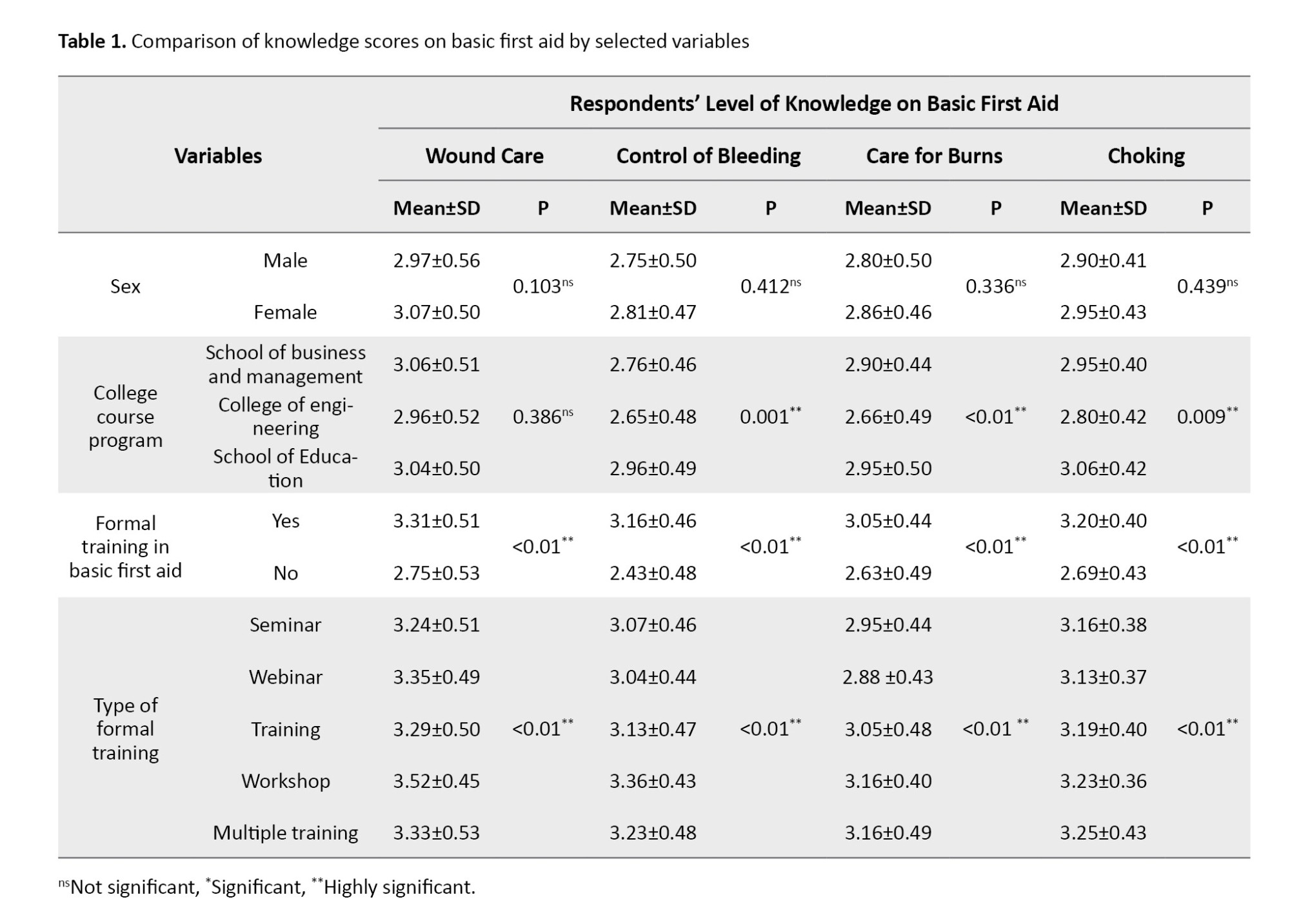
The respondents generally demonstrated fair to good knowledge in basic first aid. Among the four areas, wound care had the highest mean score (Mean±SD, 3.52±0.45) among those who underwent workshop training, while bleeding control had the lowest score (Mean±SD, 2.43±0.48) among those without formal training.
Independent t-tests showed no significant differences in knowledge scores between male and female respondents across all domains (P>0.05). In contrast, respondents who had received any form of formal first aid training scored significantly higher in all areas of knowledge (P<0.01), suggesting a strong association between training exposure and knowledge level.
One-way ANOVA results revealed that the type of college program had a significant effect on the knowledge of bleeding control, burn care, and choking (P<0.01), with educated students outperforming peers in other disciplines. Similarly, the type of formal training (seminars, webinars, workshops, etc.) was significantly associated with differences in knowledge scores across all areas (P<0.01), with workshops and multiple training types yielding the highest mean scores.
All assumptions for parametric testing—including normality and homogeneity of variances—were tested and met prior to analysis. A summary of comparative mean scores, standard deviations, and significance levels by sex, college program, training exposure, and training type is presented in Table 1.
Discussion
This study found that non-medical first-year students demonstrated fair to good knowledge in basic first aid. Among the four dimensions assessed, the highest mean score was observed in wound care, while the lowest was in bleeding control. These results highlight uneven knowledge across first aid areas, suggesting a need for targeted educational interventions.
With regard to demographic factors, no significant difference in first aid knowledge was found between male and female students. This outcome is in agreement with studies by Melvin and Barboza [7] and Huy et al. [8], which concluded that sex was not significantly associated with first aid knowledge or willingness to perform first aid. These results suggest that sex does not influence the acquisition or retention of basic first aid skills.
Ritu [9] reported that a majority of non-medical students lacked sufficient basic first aid knowledge, particularly in managing everyday emergencies, such as bleeding and fractures. Similarly, Ahmer et al. [10] found that most students at Karachi University demonstrated low knowledge in burn care and choking but showed strong interest in acquiring first aid skills. These findings align with the current study’s results, emphasizing the necessity of improving first aid education among non-medical students.
However, significant differences in knowledge were found when comparing students across college course programs. Students from the School of Education consistently demonstrated higher knowledge scores than those from Engineering and Business. This may reflect variations in curriculum emphasis or exposure to health-related content, echoing the findings of Ahmer et al. [10], who reported disparities across academic disciplines.
Students who had received formal training—particularly through workshops—consistently scored higher in all dimensions of first aid knowledge. These findings reinforce those of Mohajervatan et al. [11], who demonstrated that early and structured first aid training significantly improves knowledge and practical skills. Similarly, previous research by Cao et al. [12] and Sutono and Achmad [13] supports the effectiveness of hands-on and varied training methods in building first aid competence. The positive impact of multiple training formats in the current study suggests that combining approaches—such as seminars, webinars, and workshops—may enhance learning outcomes. Finally, the observed gaps in knowledge underline the need for integrating formal first aid education into university curricula for non-medical students. Participation in structured, interactive training not only improves knowledge retention but also equips students to respond effectively in emergencies. Encouraging broader access to these training opportunities can help empower individuals to adopt health-promoting behaviors and provide competent care in the absence of professional help. However, the study is limited by its focus on a single university and reliance on self-reported data, which may introduce response bias. Additionally, the absence of practical assessment limits the evaluation to theoretical knowledge, not actual first aid performance.
Conclusion
The study concluded that the overall level of basic first aid knowledge among non-medical first-year students was fair to good. While gender did not significantly influence knowledge levels, the type of college program and participation in formal training played crucial roles. Significant knowledge gaps were identified in key areas, such as bleeding control, burn care, and choking response. Students who had undergone formal first aid training, especially through interactive workshops, demonstrated notably higher knowledge scores. These findings highlight the need to incorporate structured, hands-on first aid training into university programs to better equip students for emergency situations and promote public safety.
Take home messages
Comprehensive and practical first aid training, especially interactive workshops, significantly boost knowledge and preparedness among non-medical students, highlighting the importance of such training in educational curricula to enhance public health and safety.
Ethical Considerations
Compliance with ethical guidelines
This study was approved by the Ethics Committee of Xavier University-Ateneo de Cagayan, Cagayan de Oro, Philippines (Code: NSG-2024001284). Informed consent was obtained from all participants before their inclusion in the study.
Funding
This research did not receive any grant from funding agencies in the public, commercial, or non-profit sectors.
Authors contributions
Conceptualization: Celine Y. Paduit, Celine Franscisca S. Payopanin, Paolo B. Araune and Ivy R. Go; Supervision: Ivy R. Go; Methodology: Zean Ansel C. Piloton, Krystelle Heart A. Porras, Sidic, Sydney James T. Soler and Sherry Levita Swanenberg; Investigation: Elizabeth Julia P. Tayag, Kaye Dominique Teves, Christian Dale P. Yasay; Writing: Samantha Celine Y. Paduit, Celine Franscisca S. Payopanin, Elizabeth Julia P. Tayag, Kaye Dominique Teves, Yasay, Piloton, Porras, Sidic, Soler and Swanenberg; Review & editing: Paolo B. Araune and Ivy R. Go; Data collection: Zean Ansel C. Piloton, Krystelle Heart A. Porras, Ammarah D. Sidic, Sydney James T. Soler and Sherry Levita Swanenberg; Data analysis: Elizabeth Julia P. Tayag, Kaye Dominique Teves, Yasay and Paolo B. Araune.
Conflict of interest
The authors declared no conflicts of interest.
Acknowledgements
The authors would like to express their gratitude to all participants in this study for their time and cooperation.
References
First aid plays a vital role in emergency preparedness, equipping individuals with the ability to provide immediate and temporary care to those experiencing sudden illness or injury [1]. Its timely application can stabilize victims and prevent further harm until professional medical help arrives [1]. However, even in situations where first aid could make a critical difference, fear, lack of confidence, and insufficient knowledge often prevent bystanders from acting [2].
In non-clinical settings, such as homes, where healthcare professionals are typically absent, the competence of laypersons becomes particularly vital. Home accidents, for example, account for a significant proportion of childhood injuries worldwide, with immediate responders often being family members, such as mothers or siblings [3].
Recognizing the value of early intervention, the Philippine government enacted Republic Act No. 10871, or the Basic Life Support Training in Schools Act, requiring all primary and secondary schools to provide age-appropriate training in life-saving skills [4]. Complementing this, the good samaritan act aims to encourage bystander assistance by limiting legal liabilities. However, while designed to empower, such legislation may inadvertently reinforce the perception that only trained medical personnel or students are responsible for first aid delivery—potentially discouraging untrained individuals from intervening [5].
Despite these national initiatives, limited research has examined the first aid knowledge of non-medical college students, a large yet underutilized segment in community emergency preparedness. By assessing the level of first aid knowledge among selected non-medical first-year students in a tertiary university, this study aimed to identify knowledge gaps and highlight opportunities for integrating more inclusive, skills-based first aid training into educational programs. The findings can inform strategies that strengthen students’ confidence and capacity to act during emergencies, ultimately improving community resilience.
Materials and Methods
Research design
This study utilized a descriptive, cross-sectional design to assess first aid knowledge among selected non-medical first-year students. As noted by aggarwal and ranganathan [6], such a design is used to document characteristics and perceptions without manipulating variables.
Sample, sample size, and sampling technique
The respondents were non-medical freshmen officially enrolled in three college programs. Inclusion criteria encompassed first-year students aged 18 and above, regardless of prior participation in basic first aid seminars, workshops, or training within the past year, and regardless of whether they had rendered first aid. Students from medical-related programs, such as those enrolled in the School of Medicine and the College of Nursing, as well as upper-year students beyond the first year, were excluded.
Stratified random sampling was employed by dividing the total population of 544 students—obtained from official enrollment records provided by the deans—into three strata based on their college programs: The School of education, the school of business and management, and the college of engineering. Within each stratum, a list of eligible students was compiled, and simple random sampling using a random number generator was conducted to ensure equal representation and minimize selection bias.
The sample size was computed using cochran’s formula for finite populations, with the parameters set at a 95% confidence level, a 5% margin of error, and an assumed population proportion (p) of 0.5 to ensure maximum variability. This resulted in a required sample of 369 respondents, proportionally allocated as follows: 103 from the School of Education, 143 from the School of Business and Management, and 123 from the College of Engineering.
Data collection process
The data collection process began with a formal meeting between the researchers and the Deans of the three colleges to introduce the study and secure institutional approval. Coordination with class advisers and block representatives followed to facilitate the distribution of the online questionnaire. The survey link, accessible via a QR code, was sent to eligible students who voluntarily consented to participate. A cover letter accompanied the questionnaire, outlining the study’s objectives, assuring confidentiality, and emphasizing the voluntary nature of participation.
The online survey was available for one week. All responses were collected through Google Forms and securely backed up in password-protected Excel files, in accordance with the Data Privacy Act of 2012. No incentives were provided, and participants retained the right to withdraw at any time.
Instrument
A researcher-developed questionnaire was used to gather relevant data. It consisted of 30 items grouped into four sections: (1) demographic information (age, sex, and college program), (2) prior training or attendance in basic first aid seminars, (3) experience in providing first aid, and (4) knowledge-based items covering wound care, bleeding control, burns, and choking management. Knowledge items were measured using a 4-point Likert scale (1=strongly disagree to 4=strongly agree) to assess perceived knowledge and confidence in basic first aid.
To ensure validity, the questionnaire underwent face and content validation by three clinical instructors and certified first aid trainers from the College of Nursing. They reviewed the instrument for relevance, clarity, and coverage. Construct validity was established by aligning the items with first aid guidelines from the Philippine Red Cross and the American Heart Association. A pilot test was conducted with 30 non-participating students from similar programs, and the instrument was revised accordingly for clarity.
Reliability testing yielded a Cronbach’s α of 0.81 for the knowledge section, indicating good internal consistency. Knowledge scores were interpreted using predefined cut-offs to categorize overall knowledge as poor, fair, good, or excellent.
Data analysis
The knowledge scores were computed by summing the responses from the knowledge of basic first aid section, which used a 4-point Likert scale (1=strongly disagree to 4=strongly agree). Higher total scores indicated greater perceived knowledge of first aid practices. These scores were then classified into four categories—poor, fair, good, and excellent—based on predefined cut-off ranges established during pilot testing and literature review.
To determine whether there were statistically significant differences in knowledge scores based on demographic and training-related variables, the researchers used independent samples t-tests (for comparisons between the two groups) and one-way ANOVA (for comparisons among the three or more groups). Prior to conducting these parametric tests, assumptions of normality and homogeneity of variances were tested. Normality was assessed using the Shapiro-Wilk test and visual inspection of histograms and Q-Q plots, while Levene’s test was used to assess homogeneity of variances. A 95% confidence level and a significance threshold of P<0.05 were used to determine statistical significance.
Results
Bottom of form
The respondents generally demonstrated fair to good knowledge in basic first aid. Among the four areas, wound care had the highest mean score (Mean±SD, 3.52±0.45) among those who underwent workshop training, while bleeding control had the lowest score (Mean±SD, 2.43±0.48) among those without formal training.
Independent t-tests showed no significant differences in knowledge scores between male and female respondents across all domains (P>0.05). In contrast, respondents who had received any form of formal first aid training scored significantly higher in all areas of knowledge (P<0.01), suggesting a strong association between training exposure and knowledge level.
One-way ANOVA results revealed that the type of college program had a significant effect on the knowledge of bleeding control, burn care, and choking (P<0.01), with educated students outperforming peers in other disciplines. Similarly, the type of formal training (seminars, webinars, workshops, etc.) was significantly associated with differences in knowledge scores across all areas (P<0.01), with workshops and multiple training types yielding the highest mean scores.
All assumptions for parametric testing—including normality and homogeneity of variances—were tested and met prior to analysis. A summary of comparative mean scores, standard deviations, and significance levels by sex, college program, training exposure, and training type is presented in Table 1.
Discussion
This study found that non-medical first-year students demonstrated fair to good knowledge in basic first aid. Among the four dimensions assessed, the highest mean score was observed in wound care, while the lowest was in bleeding control. These results highlight uneven knowledge across first aid areas, suggesting a need for targeted educational interventions.
With regard to demographic factors, no significant difference in first aid knowledge was found between male and female students. This outcome is in agreement with studies by Melvin and Barboza [7] and Huy et al. [8], which concluded that sex was not significantly associated with first aid knowledge or willingness to perform first aid. These results suggest that sex does not influence the acquisition or retention of basic first aid skills.
Ritu [9] reported that a majority of non-medical students lacked sufficient basic first aid knowledge, particularly in managing everyday emergencies, such as bleeding and fractures. Similarly, Ahmer et al. [10] found that most students at Karachi University demonstrated low knowledge in burn care and choking but showed strong interest in acquiring first aid skills. These findings align with the current study’s results, emphasizing the necessity of improving first aid education among non-medical students.
However, significant differences in knowledge were found when comparing students across college course programs. Students from the School of Education consistently demonstrated higher knowledge scores than those from Engineering and Business. This may reflect variations in curriculum emphasis or exposure to health-related content, echoing the findings of Ahmer et al. [10], who reported disparities across academic disciplines.
Students who had received formal training—particularly through workshops—consistently scored higher in all dimensions of first aid knowledge. These findings reinforce those of Mohajervatan et al. [11], who demonstrated that early and structured first aid training significantly improves knowledge and practical skills. Similarly, previous research by Cao et al. [12] and Sutono and Achmad [13] supports the effectiveness of hands-on and varied training methods in building first aid competence. The positive impact of multiple training formats in the current study suggests that combining approaches—such as seminars, webinars, and workshops—may enhance learning outcomes. Finally, the observed gaps in knowledge underline the need for integrating formal first aid education into university curricula for non-medical students. Participation in structured, interactive training not only improves knowledge retention but also equips students to respond effectively in emergencies. Encouraging broader access to these training opportunities can help empower individuals to adopt health-promoting behaviors and provide competent care in the absence of professional help. However, the study is limited by its focus on a single university and reliance on self-reported data, which may introduce response bias. Additionally, the absence of practical assessment limits the evaluation to theoretical knowledge, not actual first aid performance.
Conclusion
The study concluded that the overall level of basic first aid knowledge among non-medical first-year students was fair to good. While gender did not significantly influence knowledge levels, the type of college program and participation in formal training played crucial roles. Significant knowledge gaps were identified in key areas, such as bleeding control, burn care, and choking response. Students who had undergone formal first aid training, especially through interactive workshops, demonstrated notably higher knowledge scores. These findings highlight the need to incorporate structured, hands-on first aid training into university programs to better equip students for emergency situations and promote public safety.
Take home messages
Comprehensive and practical first aid training, especially interactive workshops, significantly boost knowledge and preparedness among non-medical students, highlighting the importance of such training in educational curricula to enhance public health and safety.
Ethical Considerations
Compliance with ethical guidelines
This study was approved by the Ethics Committee of Xavier University-Ateneo de Cagayan, Cagayan de Oro, Philippines (Code: NSG-2024001284). Informed consent was obtained from all participants before their inclusion in the study.
Funding
This research did not receive any grant from funding agencies in the public, commercial, or non-profit sectors.
Authors contributions
Conceptualization: Celine Y. Paduit, Celine Franscisca S. Payopanin, Paolo B. Araune and Ivy R. Go; Supervision: Ivy R. Go; Methodology: Zean Ansel C. Piloton, Krystelle Heart A. Porras, Sidic, Sydney James T. Soler and Sherry Levita Swanenberg; Investigation: Elizabeth Julia P. Tayag, Kaye Dominique Teves, Christian Dale P. Yasay; Writing: Samantha Celine Y. Paduit, Celine Franscisca S. Payopanin, Elizabeth Julia P. Tayag, Kaye Dominique Teves, Yasay, Piloton, Porras, Sidic, Soler and Swanenberg; Review & editing: Paolo B. Araune and Ivy R. Go; Data collection: Zean Ansel C. Piloton, Krystelle Heart A. Porras, Ammarah D. Sidic, Sydney James T. Soler and Sherry Levita Swanenberg; Data analysis: Elizabeth Julia P. Tayag, Kaye Dominique Teves, Yasay and Paolo B. Araune.
Conflict of interest
The authors declared no conflicts of interest.
Acknowledgements
The authors would like to express their gratitude to all participants in this study for their time and cooperation.
References
- Monge MB, Perez RD. Student’s awareness in basic first aid and their academic performance. International Journal of Multidisciplinary Research and Analysis. 2021; 4(7):1043-8. [DOI:10.47191/ijmra/v4-i7-20]
- Awasthi S, Pamei G, Solanki HK, Kaur A, Bhatt M. Knowledge, attitude, and practice of first aid among the commercial drivers in the Kumaon region of India. Journal of Family Medicine and Primary Care. 2019; 8(6):1994-8. [DOI:10.4103/jfmpc.jfmpc_295_19] [PMID]
- Can D, Bayer N. Determining the mothers’ first-aid self-efficacy in home accidents in Turkey. European Journal of Environment and Public Health. 2023; 7(3):1-6. [DOI:10.29333/ejeph/13376]
- Supreme Court E-Library. An act requiring basic education students to undergo age-appropriate basic life support training. 2016 [Updated 2016 August 1]. Available from: [Link]
- Quismorio E. Proposed “good samaritan act” filed; here’s what it is for. 2022 [Updated 2022 August 3]. Available from: [Link]
- Aggarwal R, Ranganathan P. Study designs: Part 2-descriptive studies. Perspectives in Clinical Research. 2019; 10(1):34-36.[DOI:10.4103/picr.PICR_154_18] [PMID]
- Melvin J, Barboza HR. Assessment of knowledge regarding first aid among undergraduate students: A cross-sectional study. Indian Journal of Forensic Medicine and Toxicology. 2021; 15(4):1830-1835. [DOI:10.37506/ijfmt.v15i4.16969]
- Huy LD, Tung PT, Nhu LN, Linh NT, Tra DT, Thao NV, et al. The willingness to perform first aid among high school students and associated factors in Hue, Vietnam. Plos One. 2022; 17(7):e0271567. [DOI:10.1371/journal.pone.0271567] [PMID]
- Ritu M. A study to assess the knowledge and attitude regarding first aid of common emergencies (FACE) among the non-medical students. IOSR Journal of Nursing and Health Science. 2023; 12(5):17-22. [Link]
- Ahmer Z, Moin D, Khalil A, Akram A, Obaid E, Jawaid H. Knowledge, attitude and practices of first aid among non-medical students of Karachi University. Liaquat National Journal of Primary Care. 2020; 2(1):22-8. [Link]
- Mohajervatan A, Raeisi AR, Atighechian G, Tavakoli N, Muosavi H. The efficacy of operational first aid training course in preschool children. Health in Emergencies and Disasters Quarterly. 2020; 6(1):17-22. [DOI:10.32598/hdq.6.1.149.2]
- Cao B, Lang JL, Chen J, Yu J, Tan L, Meng Y, et al. Implementing the first-aid education into the college curriculum in China: The efficacy study of the first-aid workshop at Wenzhou-Kean University. Journal of Biosciences and Medicines. 2018; 6(12):79-87. [DOI:10.4236/jbm.2018.612008]
- Sutono, Achmad BF. Effectiveness of first-aid training in school among high school students in Kulon Progo, Indonesia. International Journal of Research in Medical Sciences. 2020; 8(3):974-978. [DOI:10.18203/2320-6012.ijrms20200765]
Type of Study: Original Article |
Subject:
Health Education
Send email to the article author
| Rights and permissions | |
 |
This work is licensed under a Creative Commons Attribution-NonCommercial 4.0 International License. |

This is an open access article distributed under the terms of the Creative Commons Attribution License (CC-By-NC), which permits use, distribution, and reproduction in any medium, provided the original work is properly cited and is not used for commercial purposes.
Contact Information