Volume 13, Issue 4 (Autumn 2025)
Iran J Health Sci 2025, 13(4): 329-332 |
Back to browse issues page



Ethics code: IR.ARUMS.REC.1400.317
Clinical trials code: IR.ARUMS.REC.1400.317


Download citation:
BibTeX | RIS | EndNote | Medlars | ProCite | Reference Manager | RefWorks
Send citation to:


BibTeX | RIS | EndNote | Medlars | ProCite | Reference Manager | RefWorks
Send citation to:
Shahbazzadegan S. Sex Ratio Imbalance and Deficit of Female Births in Ardabil Province, Iran. Iran J Health Sci 2025; 13 (4) :329-332
URL: http://jhs.mazums.ac.ir/article-1-1079-en.html
URL: http://jhs.mazums.ac.ir/article-1-1079-en.html


Department of Midwifery, School of Nursing and Midwifery, Ardabil University of Medical Sciences, Ardabil, Iran. , samirashahbazzadegan2000@yahoo.com
Full-Text [PDF 511 kb]
(362 Downloads)
| Abstract (HTML) (1546 Views)
Full-Text: (1579 Views)
Introduction
Sex ratio at birth (SRB) is the ratio of males born per 100 females, which naturally ranges between 103 and 107 [1]. It is remarkably constant in human populations [2]. Gender preferences for offspring exist worldwide, with varying patterns [3]. In Iran, male preference as a lasting cultural characteristic, leads some parents to prefer males and eliminate females. Although SRB levels in Iran are currently within normal ranges, they are increasing and abnormal in some provinces [3, 4]. In addition to the declining live birth rate, the highest reported sex ratio in the country belongs to Ardabil City, which is 127 male births for every 100 female births [4]. “Masculinisation” is a clear aspect of Asia’s recent population dynamics that cause an unexpected increase in the number of males in its population [5].
Social determinants of health (SDH) have a greater impact than medical care, and gender is one such determinant [6]. The fertility rate is declining in many countries, including Iran and Ardabil province [4]. Given the country’s priorities in supporting families and the lack of comprehensive SRB studies, this research was conducted to determine the sex ratio imbalance and the deficit of female births in Ardabil Province, Iran.
Materials and Methods
In this cross-sectional descriptive study, the data were collected from an integrated health system from Mar 2017 to Feb 2024 in Ardabil province. The inclusion criteria were live births registered in public healthcare facilities in Ardabil Province between 2017 and 2024. The gender of all newborns at birth that were registered in the integrated health system since the beginning of the study in 2017 was collected.
The sex ratio and expected female births for each year was calculated. Sex ratio was calculated by dividing the number of live male births by the number of live female births and multiplying the result by 100. The expected number of female births was calculated by dividing the number of live male births by 105 and multiplying by 100 [1]. The data were compared to the normal SRB with using SPSS software, version 16.
Results
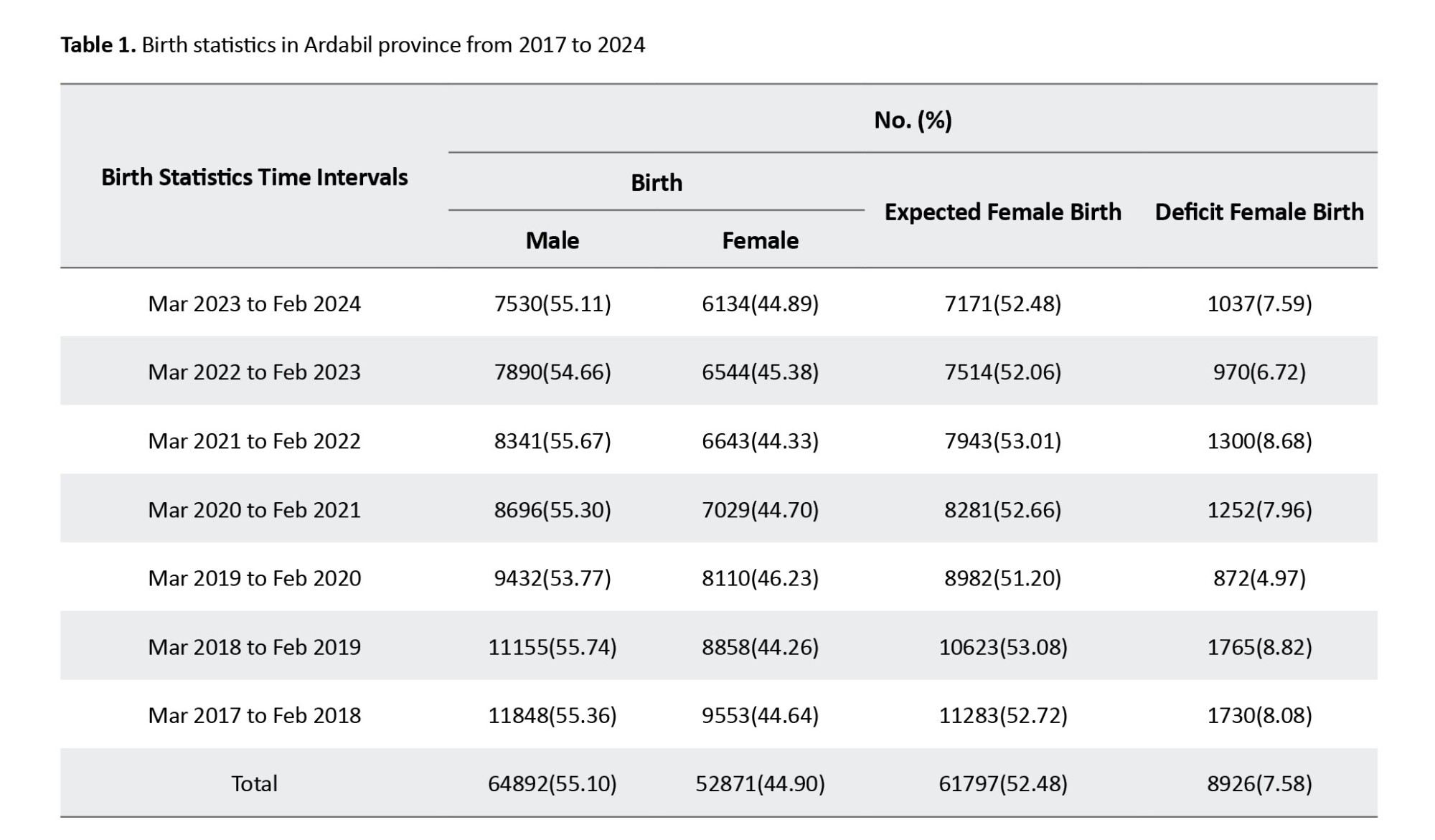
The results showed that from 2017 to 2024, 117763 births occurred in Ardabil province (64892 males and 52871 females), while 61797 female births were expected to achieve a normal SRB. In other words, achieve (Table 1).
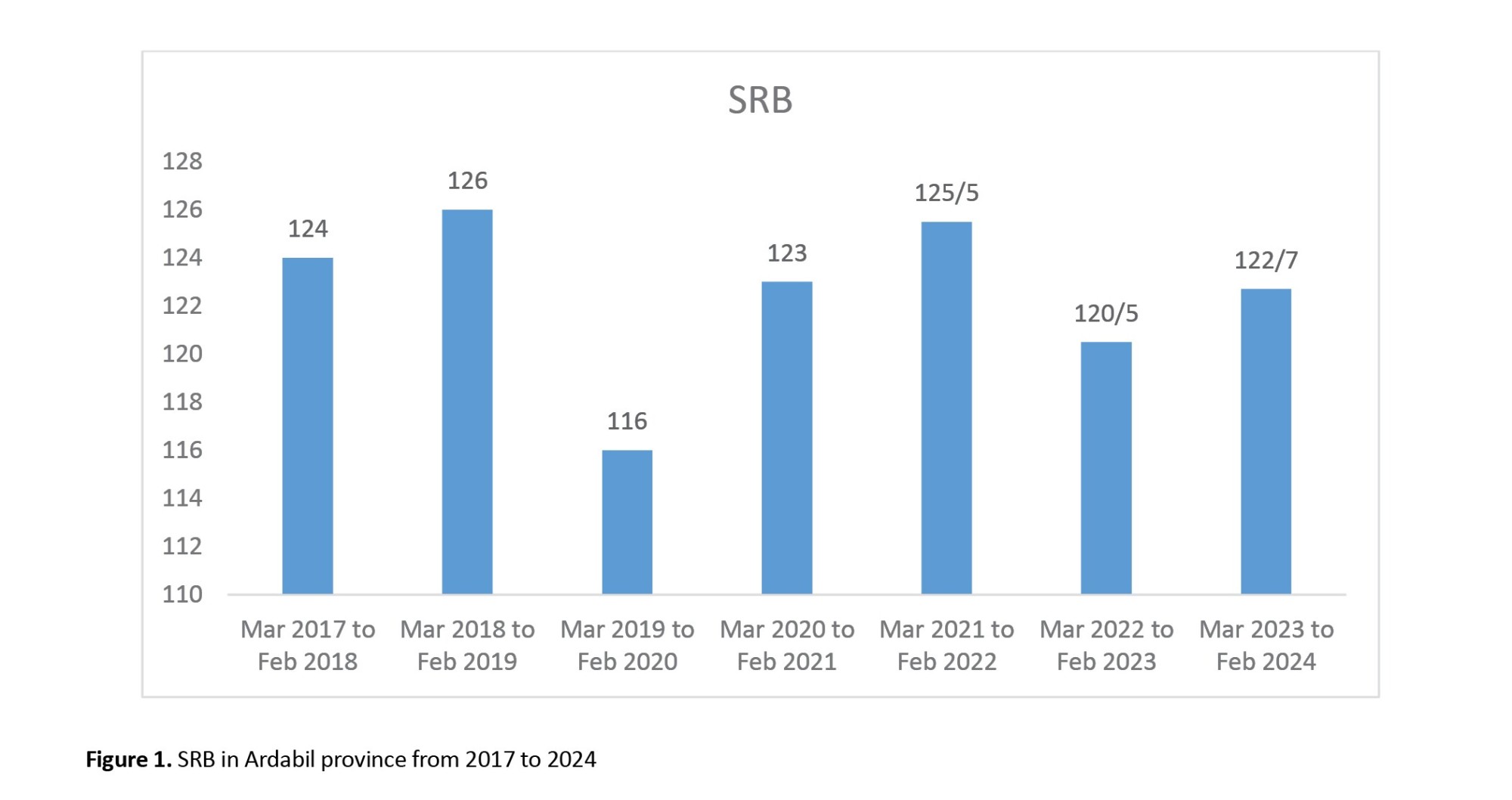
Comparison using a one-sample t-test showed that the mean SRB over the seven years (122.5±3.42) was significantly higher than the criterion value (normal SRB: 105) ([P<0.001], [95% CI, 14.37%, 20.69%]).
The sex ratio was higher than normal in all study years (Figure 1).
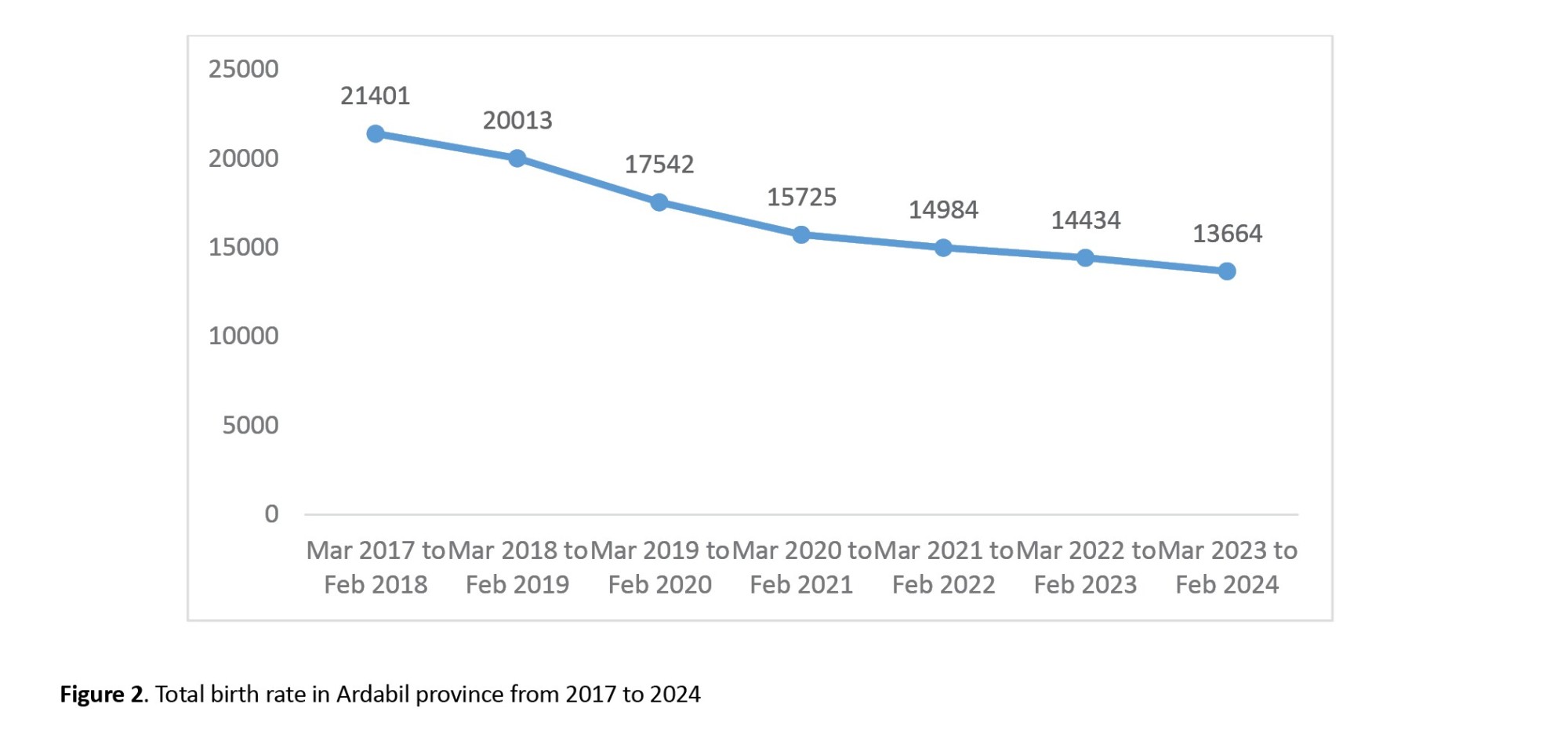
The total birth rate decreased continuously during the study period (Figure 2). From 2017 to 2024, the birth rates of males and females decreased by 63.6% and 64.2%, respectively.
Discussion
In addition to the decreasing trend in the number of births in Ardabil province, 8926 females were born fewer than the expected value in seven recent years. In other words, during the past seven years, about 9,000 “missing women” were identified in Ardabil Province. This finding aligns with that of Sen who showed that there are about 100 million missing women in West Asia and North Africa [4]. A systematic assessment showed that there were 12 countries with strong statistical evidence of SRB imbalance from 1970 to 2017, resulting in 23.1 million missing female births globally [6]. In this regard, large groups of “surplus” men appear in society, which raises concerns about their non-marriage and marginalization. This situation may lead to anti-social behavior and violence, threatening social stability and security [1].
The increased SRB in Ardabil may be due to society’s preference for boys, the decrease in the birth rate, and access to technology. The missing population of girls is referred to as the “missing women of Asia” due to the strong preference for boys in some countries [5]. Clément et al. reported that son preference and the perpetuation of patriarchal norms hinder gender equality [7, 8].
A strength of the study is the use of an integrated health system, which significantly reduces the probability of reporting biases in the sex ratio. A weakness of the study is the calculation of the SRB without considering other demographic characteristics.
Conclusion
During the past seven years, about 9000 “missing females” were identified in Ardabil province, reflecting significant gender bias with potential repercussions for social stability, marriage patterns, and gender equity. Public awareness campaigns and legal restrictions on sex-selective procedures are suggested.
Ethical Considerations
Compliance with ethical guidelines
This study was approved by the Ethics Committee of Ardabil University of Medical Sciences, Ardabil, Iran (Code: IR.ARUMS. REC.1400.317).
Funding
This research did not receive any grant from funding agencies in the public, commercial, or non-profit sectors.
Acknowledgements
The author thanks the Health Statistics Center of Ardabil Province for the cooperation.
References
Sex ratio at birth (SRB) is the ratio of males born per 100 females, which naturally ranges between 103 and 107 [1]. It is remarkably constant in human populations [2]. Gender preferences for offspring exist worldwide, with varying patterns [3]. In Iran, male preference as a lasting cultural characteristic, leads some parents to prefer males and eliminate females. Although SRB levels in Iran are currently within normal ranges, they are increasing and abnormal in some provinces [3, 4]. In addition to the declining live birth rate, the highest reported sex ratio in the country belongs to Ardabil City, which is 127 male births for every 100 female births [4]. “Masculinisation” is a clear aspect of Asia’s recent population dynamics that cause an unexpected increase in the number of males in its population [5].
Social determinants of health (SDH) have a greater impact than medical care, and gender is one such determinant [6]. The fertility rate is declining in many countries, including Iran and Ardabil province [4]. Given the country’s priorities in supporting families and the lack of comprehensive SRB studies, this research was conducted to determine the sex ratio imbalance and the deficit of female births in Ardabil Province, Iran.
Materials and Methods
In this cross-sectional descriptive study, the data were collected from an integrated health system from Mar 2017 to Feb 2024 in Ardabil province. The inclusion criteria were live births registered in public healthcare facilities in Ardabil Province between 2017 and 2024. The gender of all newborns at birth that were registered in the integrated health system since the beginning of the study in 2017 was collected.
The sex ratio and expected female births for each year was calculated. Sex ratio was calculated by dividing the number of live male births by the number of live female births and multiplying the result by 100. The expected number of female births was calculated by dividing the number of live male births by 105 and multiplying by 100 [1]. The data were compared to the normal SRB with using SPSS software, version 16.
Results
The results showed that from 2017 to 2024, 117763 births occurred in Ardabil province (64892 males and 52871 females), while 61797 female births were expected to achieve a normal SRB. In other words, achieve (Table 1).
Comparison using a one-sample t-test showed that the mean SRB over the seven years (122.5±3.42) was significantly higher than the criterion value (normal SRB: 105) ([P<0.001], [95% CI, 14.37%, 20.69%]).
The sex ratio was higher than normal in all study years (Figure 1).
The total birth rate decreased continuously during the study period (Figure 2). From 2017 to 2024, the birth rates of males and females decreased by 63.6% and 64.2%, respectively.
Discussion
In addition to the decreasing trend in the number of births in Ardabil province, 8926 females were born fewer than the expected value in seven recent years. In other words, during the past seven years, about 9,000 “missing women” were identified in Ardabil Province. This finding aligns with that of Sen who showed that there are about 100 million missing women in West Asia and North Africa [4]. A systematic assessment showed that there were 12 countries with strong statistical evidence of SRB imbalance from 1970 to 2017, resulting in 23.1 million missing female births globally [6]. In this regard, large groups of “surplus” men appear in society, which raises concerns about their non-marriage and marginalization. This situation may lead to anti-social behavior and violence, threatening social stability and security [1].
The increased SRB in Ardabil may be due to society’s preference for boys, the decrease in the birth rate, and access to technology. The missing population of girls is referred to as the “missing women of Asia” due to the strong preference for boys in some countries [5]. Clément et al. reported that son preference and the perpetuation of patriarchal norms hinder gender equality [7, 8].
A strength of the study is the use of an integrated health system, which significantly reduces the probability of reporting biases in the sex ratio. A weakness of the study is the calculation of the SRB without considering other demographic characteristics.
Conclusion
During the past seven years, about 9000 “missing females” were identified in Ardabil province, reflecting significant gender bias with potential repercussions for social stability, marriage patterns, and gender equity. Public awareness campaigns and legal restrictions on sex-selective procedures are suggested.
Ethical Considerations
Compliance with ethical guidelines
This study was approved by the Ethics Committee of Ardabil University of Medical Sciences, Ardabil, Iran (Code: IR.ARUMS. REC.1400.317).
Funding
This research did not receive any grant from funding agencies in the public, commercial, or non-profit sectors.
Acknowledgements
The author thanks the Health Statistics Center of Ardabil Province for the cooperation.
References
- Chao F, Gerland P, Cook AR, Guilmoto CZ, Alkema L. Projecting sex imbalances at birth at global, regional and national levels from 2021 to 2100: Scenario-based Bayesian probabilistic projections of the sex ratio at birth and missing female births based on 3.26 billion birth records. BMJ Global Health. 2021; 6(8):e005516. [DOI:10.1136/bmjgh-2021-005516] [PMID]
- Vaughan RP. Does women’s education improve the sex ratio at birth? Gender, agency and sex-selective abortion in South and East Asia: A critical literature review. Women’s Studies International Forum. 2025; Vol. 109:103050. [DOI:10.1016/j.wsif.2024.103050]
- Kazemi S. [Trend of change in the sex ratio at birth in Iran: Factors and contexts (Persian)]. Journal of Population Association of Iran. 2020; 15(30):289-320. [DOI:10.22034/jpai.2021.521242.1171]
- Shahbazzadegan S. [A study on the sex ratio in ardabil, iran during the last decade (Persian)]. Journal of Midwifery and Reproductive Health. 2023; 11(1):3638-43. [DOI:10.22038/jmrh.2022.65965.192]
- Sen A. More than 100 million women are missing. In: Naffine N, editor. Gender and justice. London: Routledge; 2017. [DOI:10.4324/9781315093727-13] [PMID]
- Salehnia N, Assari Arani A, Olyaeemanesh A, Sadeghi Saghdel H. Identifying and prioritizing social determinants of population health in Iran: A mixed method research. Iranian Journal of Health Sciences. 2023; 11(2):75-86. [DOI:10.32598/ijhs.11.2.925.1]
- Chao F, Gerland P, Cook AR, Alkema L. Systematic assessment of the sex ratio at birth for all countries and estimation of national imbalances and regional reference levels. Proceedings of the National Academy of Sciences. 2019; 116(19):9303-11. [DOI:10.1073/pnas.1812593116] [PMID]
- Clément M, Levasseur P, Seetahul S. Sex ratio and fertility preferences in India: A longitudinal analysis. World Development. 2025; 192:107046. [DOI:10.1016/j.worlddev.2025.107046]
Type of Study: Original Article |
Subject:
Community Health
Send email to the article author
| Rights and permissions | |
 |
This work is licensed under a Creative Commons Attribution-NonCommercial 4.0 International License. |

This is an open access article distributed under the terms of the Creative Commons Attribution License (CC-By-NC), which permits use, distribution, and reproduction in any medium, provided the original work is properly cited and is not used for commercial purposes.
Contact Information