Volume 14, Issue 1 (Winter 2026)
Iran J Health Sci 2026, 14(1): 17-24 |
Back to browse issues page



Ethics code: XU REC Package No. NSG-2024001295
Clinical trials code: N/A


Download citation:
BibTeX | RIS | EndNote | Medlars | ProCite | Reference Manager | RefWorks
Send citation to:


BibTeX | RIS | EndNote | Medlars | ProCite | Reference Manager | RefWorks
Send citation to:
Pacuribot A J O, Perreras J A B, Reduca N B R P, Reyes P M M E, Roa M E M, Rodriguez G G, et al . Meal Frequency Patterns Among Third-year Nursing Students: The Role of Living Arrangements and Academic Demands. Iran J Health Sci 2026; 14 (1) :17-24
URL: http://jhs.mazums.ac.ir/article-1-1004-en.html
URL: http://jhs.mazums.ac.ir/article-1-1004-en.html
Amara Jaina O. Pacuribot 
 , Justin Angelo B. Perreras , Noireich Benjamin Rogue P. Reduca , Paul Mari Mathew E. Reyes , Mikee Ely M. Roa , Graciela G. Rodriguez , Maria Alexa T. Tiñoña , Lance Patrick B. Toribio , Sofia Cris T. Vitor , Maria Lea Anthoinette Q. Yema , Shelwyn C. Zaluaga , Paolo B. Araune * , Yvette M. Batar
, Justin Angelo B. Perreras , Noireich Benjamin Rogue P. Reduca , Paul Mari Mathew E. Reyes , Mikee Ely M. Roa , Graciela G. Rodriguez , Maria Alexa T. Tiñoña , Lance Patrick B. Toribio , Sofia Cris T. Vitor , Maria Lea Anthoinette Q. Yema , Shelwyn C. Zaluaga , Paolo B. Araune * , Yvette M. Batar
Department of Mathematics, Xavier University-Ateneo de Cagayan, Cagayan de Oro, Philippines. , paraune@xu.edu.ph
Full-Text [PDF 620 kb]
(1040 Downloads)
| Abstract (HTML) (1142 Views)
References
Full-Text: (336 Views)
Introduction
College life introduces significant lifestyle adjustments, and one of the most affected health behaviors among university students is their eating patterns. International research shows that the food environment, defined by what foods are accessible and affordable in one’s surroundings, strongly influences dietary behaviors and food choices [1]. Students who shift from living with their families to living independently often encounter different food environments and routines, which may alter their meal frequency and dietary habits. These global findings underscore the importance of examining how environmental and individual factors interact to shape students’ nutritional behaviors.
In the Philippines, national nutrition data reveal concerning patterns of irregular eating behaviors among adolescents and young adults. The expanded national nutrition survey conducted by the Food and Nutrition Research Institute, Department of Science and Technology, reported that many Filipino youth exhibit inconsistent meal timing, frequent skipping of major meals, and inadequate adherence to recommended meal-frequency standards [2]. Although these surveys do not provide meal-frequency data specific to nursing students, the documented prevalence of irregular eating behaviors among Filipino young adults reflects a broader nutritional risk profile. This trend may be particularly relevant for nursing students, who typically face demanding academic schedules and clinical loads that can further disrupt regular eating patterns.
Meal frequency is an essential component of overall health, as regular eating patterns support stable energy levels, cognitive performance, and well-being [3]. Factors previously identified as influencing meal frequency among independently living students include cooking skills, food knowledge, social norms, class schedules, and availability of food resources [4]. In contrast, students who live dependently with their families often benefit from structured routines, shared meals, and easier access to prepared foods, which may help promote more consistent dietary habits.
This study focuses on third-year nursing students, a cohort known to experience an intensive academic workload, including high-pressure subjects, such as medical-surgical and psychiatric nursing [5]. These academic demands may contribute to meal skipping or irregular eating routines, as students balance lectures, clinical duties, and study requirements. Although international research has examined how living arrangements influence university students’ dietary behaviors, few studies in the Philippines have examined whether independent or dependent living arrangements affect meal frequency among nursing students. Existing local research tends to emphasize dietary diversity, nutrient intake, or food insecurity rather than meal timing or frequency. To address this gap, the present study compares meal frequency among third-year nursing students living independently and those living with others, generating new evidence to inform nutrition-focused health promotion strategies and institutional support programs.
Materials and Methods
This study employed a descriptive-comparative research design to determine whether meal frequency differed between nursing students living independently and those living dependently. This non-experimental design was selected because it allows for the comparison of naturally occurring groups without manipulation of variables. The approach enabled the researchers to describe existing patterns of meal frequency and to compare mean differences between the two living-arrangement groups using appropriate statistical tests.
The study population consisted of third-year nursing students enrolled at a private university in Northern Mindanao, Philippines, during the academic year 2023-2024. This cohort was intentionally selected because the third year represents the most academically demanding phase of the nursing curriculum, characterized by major lecture and clinical preparation courses that may influence students’ eating patterns more distinctly than in other year levels. The inclusion criteria were limited to officially enrolled third-year nursing students who were residing either independently or dependently at the time of data collection. Students on leave, those with incomplete responses, and the 11 student-researchers involved in the study were excluded to minimize self-reporting bias. After these exclusions, 241 students were deemed eligible. A minimum sample size of 149 was determined at the 95% confidence level with a 5% margin of error. Stratified sampling was used to classify participants into independently and dependently living arrangements, followed by purposive recruitment within each stratum. Because independently living students constituted a smaller, less readily identifiable subgroup, controlled snowball referrals were used solely to facilitate access to eligible participants within that stratum. A total of 34 independently living students and 115 dependently living students completed the survey. The unequal group sizes reflected the actual distribution of living arrangements in the population; nevertheless, both groups met the required sample thresholds for comparative analysis.
The data were collected through an online system using web-based forms, which was the most practical method. The process began with the researchers obtaining approval from the college dean by submitting a consent form to ensure compliance with legal and confidentiality requirements. Consent forms and questionnaires were then provided to the third-year nursing student participants via Google Forms. The researchers contacted block representatives to determine the number of students in each living arrangement stratum and distributed the survey accordingly. They created a group chat to send the questionnaire and a poll to track respondents’ completion and living arrangements. Data collection occurred over two weeks, from April 8, 2024, to April 22, 2024, with active encouragement for participation. The responses were automatically compiled into a Google Form spreadsheet, which served as the primary reference for the study’s statistical analysis.
Data were collected using an online questionnaire that included an adapted version of the food timing screening (FTS) tool, a previously developed instrument for assessing the frequency of major meals and snacks. The questionnaire had two components: a demographic section that collected age, gender, living arrangement, and self-reported monthly household income; and a meal-frequency section consisting of 6 single-item measures for breakfast, morning snack, lunch, afternoon snack, dinner, and midnight snack. Each meal-frequency item used a 4-point categorical scale (0–1, 2–3, 4–5, and 6–7 times per week).
The adapted questionnaire underwent content validation by three faculty experts in nutrition and health research, after which minor revisions were made for clarity and contextual relevance. A pilot test with 20 nursing students from another year level demonstrated acceptable internal consistency for the frequency-based items (Cronbach α=0.82), indicating that the instrument was reliable for use in this study.
Data analysis included descriptive statistics (Mean±SD) to summarize meal-frequency scores for each eating occasion. Before group comparisons, demographic variables, age, gender, and monthly household income were examined descriptively to check for meaningful differences between independently and dependently living students that could act as potential confounders in the interpretation of results. The assumptions of parametric testing were assessed by evaluating normality through the Shapiro-Wilk test and examining homogeneity of variances using Levene’s test. As the assumptions were met, independent-samples t-tests were conducted to compare mean meal-frequency scores between the two living-arrangement groups. Statistical significance was set at P<0.05.
Throughout the research process, the researchers were dedicated to upholding stringent ethical standards to ensure the well-being and rights of the participants were respected and protected. In this study, informed consent was obtained from both the educational institution and the respondents before data collection and administration of the research instrument, ensuring that participants fully understood the research objectives, procedures, risks, and benefits. Measures were taken to establish a safe and confidential environment, allowing participants to choose to participate freely without coercion and guaranteeing the confidentiality of their information through data anonymization and secure storage. Participants were also granted the right to withdraw at any point without repercussions. The research results were used solely for academic purposes, with transparency maintained throughout, and any participant inquiries or concerns were promptly addressed. Approval from an Institutional Review Ethics Board (IREB) or Ethics Review Committee was obtained to ensure compliance with ethical standards, ultimately prioritizing the rights and welfare of the nursing students who participated in the study.
Results
Before conducting group comparisons, assumptions for parametric testing were assessed. The Shapiro-Wilk test results indicate that meal-frequency scores for all 6 eating occasions were approximately normally distributed for both independently and dependently living students. The Levene’s test further confirmed the homogeneity of variances across groups. These results supported the use of independent-samples t-tests to compare mean meal frequencies across living arrangements.
Descriptive results and t-test outcomes for all eating occasions are summarized in Table 1.
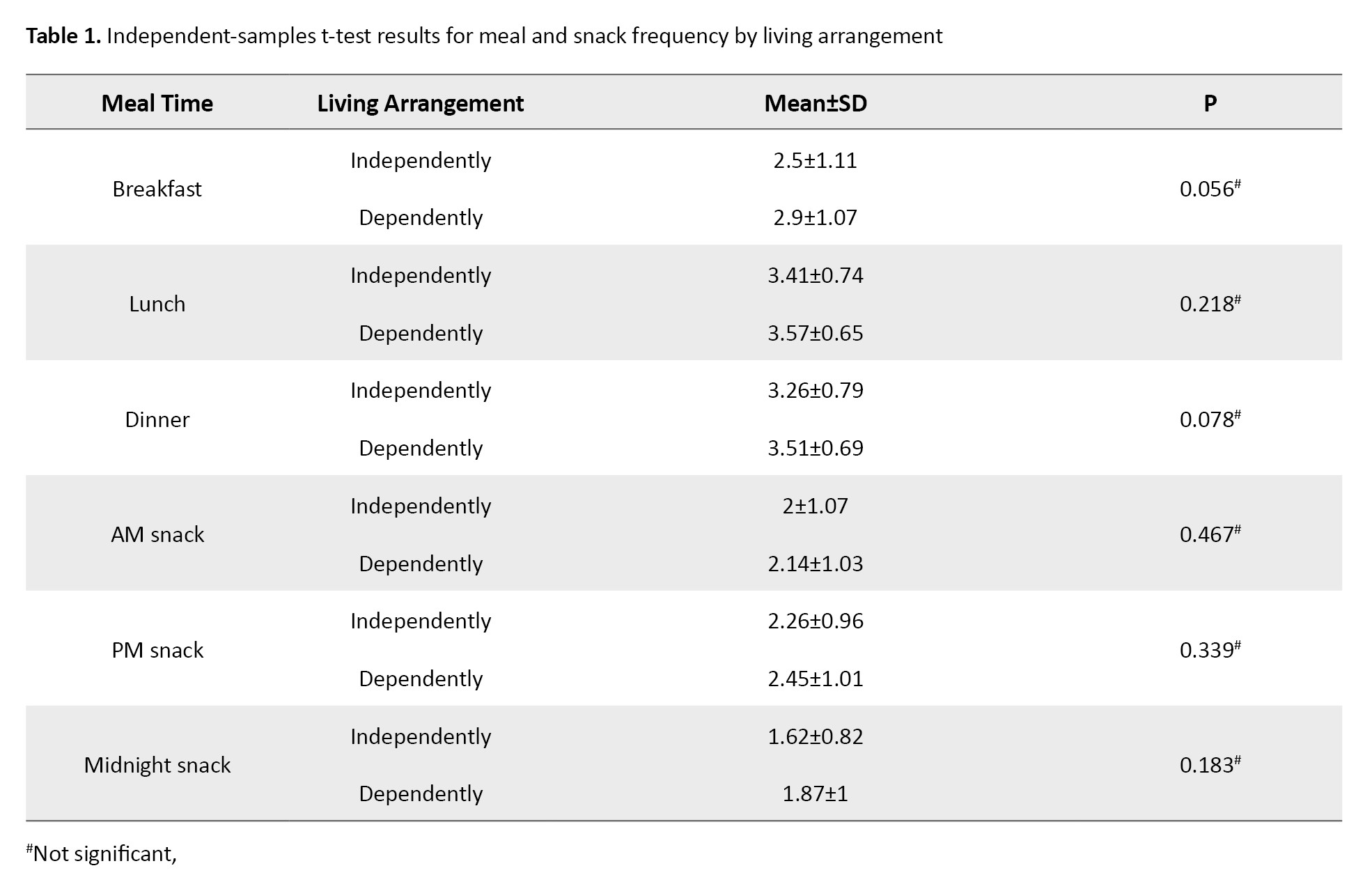
For breakfast frequency, the independently living group (Mean±SD 2.5±1.11) had a lower mean compared to the dependently living group (Mean±SD 2.9±1.07); however, this difference did not reach statistical significance (P=0.056). Lunch frequency also showed a slightly lower mean for independently living students (Mean±SD 3.41±0.74) compared with dependently living students (Mean±SD 3.57±0.65), with the difference remaining non-significant (P=0.218).
For dinner frequency, independently living students reported a Mean±SD of 3.26±0.79, while dependently living students reported a Mean±SD of 3.51±0.69. Although this comparison yielded a P value close to the threshold for significance (P=0.078), it remained non-significant. Morning snack frequency demonstrated minimal variation between the two groups, with Mean±SD of 2±1.07 for independently living students and Mean±SD 2.14±1.03 for dependently living students (P=0.467).
Afternoon snack frequency showed comparable means between independently living (Mean±SD 2.2±0.96) and dependently living students (Mean±SD 2.45±1.01), and the difference was non-significant (P=0.339). Midnight snack frequency showed the lowest mean values among all meal types, with independently living students reporting a Mean±SD of 1.62±0.82 and dependently living students reporting a Mean±SD of 1.87±1. This comparison also did not yield a statistically significant result (P=0.183). Across all 6 meal and snack categories, no statistically significant differences were detected between the two living-arrangement groups.
Discussion
This study found no statistically significant differences in the frequency of meals and snacks between third-year nursing students living independently and those living dependently. Taken together, the results suggest that living arrangement alone may not be a primary determinant of meal frequency in this cohort.
Several studies support the idea that students’ dietary behaviors result from a complex interplay of environmental and individual factors, rather than solely from housing status. Pineda et al. [1] demonstrated that food choices are shaped by the broader retail food environment and socioeconomic position, while Kabir et al. [4] highlighted the role of cooking skills, nutrition knowledge, perceptions, and social influences in shaping eating behavior among resident students. These findings are consistent with the present results, indicating that even when living circumstances differ, shared academic demands, campus routines, and social environments may homogenize meal patterns across groups.
Previous work also suggests that university-related structures can reduce differences between students living at home and those living away from home. Nelson Laska et al. [6] reported that dietary patterns and home food availability during emerging adulthood do not differ markedly by living situation, even after controlling for common contextual factors. Similarly, Bagordo et al. [7] found that Italian university students living at home or away showed comparable dietary habits, particularly when institutional schedules and campus food options were similar. These observations echo the lack of significant differences in meal frequency in the present study and suggest that institutional and academic structures may exert a stronger influence than household arrangement.
The findings on snacks align with studies showing that snacking behaviors are strongly associated with autonomy, preference, and access rather than residence type. Gangrade et al. [8] identified family and peer influence, neighborhood availability, and perceived health considerations as key drivers of snacking among adolescents in urban communities. Tripicchio et al. [9] further showed that snack frequency, size, and energy density are linked to diet quality and tend to follow developmental and lifestyle patterns. In the current context, nursing students, regardless of where they live, may share similar schedules, stressors, and access to snack foods on campus, which can help explain the comparable snack frequencies observed across living arrangements.
Theoretical frameworks help clarify why living arrangements alone may not have produced significant differences. Roy’s adaptation model emphasizes that individuals respond to environmental demands through adaptive processes that integrate personal, social, and contextual stimuli [10]. Third-year nursing students in this study face similar academic and clinical demands, which may lead them to adopt comparable meal-timing routines regardless of whether they live independently or with family. Likewise, Pender’s health promotion model underscores the role of perceived benefits, self-efficacy, interpersonal influences, and situational factors in shaping health behaviors [11, 12]. Interventions grounded in this model, such as those by Keshani et al. [13] and Carabaza et al. [14], have shown that improving diet quality and meal-related behaviors often requires targeted motivational and educational strategies rather than merely changes in structural conditions, such as residence.
Evidence from adolescent and young adult populations also suggests that family background and socioeconomic context can more influence meal regularity than simple living status alone. Parikka et al. [15] found that early childhood family background and socioeconomic position predicted meal-frequency behavior in later years. In the present study, basic socioeconomic variables did not differ substantially between groups, which may have contributed to the similarity in meal frequency. Ito et al. [16] additionally showed that family communication during mealtimes affects psychosocial well-being, indicating that qualitative aspects of family interaction, rather than co-residence alone, may be more relevant to healthful eating behaviors.
Overall, the convergence of the present findings with previous literature suggests that meal frequency among nursing students is likely shaped by a network of factors, including academic workload, time constraints, perceived health benefits, and social influences, rather than by living arrangement alone. While this study did not identify significant between-group differences, it contributes to the limited Philippine evidence on student nutrition by indicating that interventions to improve meal regularity should extend beyond housing status and instead address broader behavioral and environmental determinants.
Conclusion
This study found no significant differences in meal and snack frequency between independently and dependently living third-year nursing students, indicating that living arrangement alone does not substantially influence their eating patterns. Instead, the findings suggest that shared academic demands, similar daily schedules, and common environmental factors may shape meal frequency more strongly than residential status. These results highlight the need for nutrition initiatives in nursing education that target broader behavioral and contextual influences rather than focusing solely on students’ living situations. Practical strategies may include integrating brief nutrition education into existing courses, promoting structured meal routines despite academic workload, increasing access to affordable healthy food options within or near the university, and establishing peer-support or wellness programs that encourage regular eating patterns. Future research should investigate additional determinants of meal behavior, such as stress, time constraints, financial resources, and food access, to better inform tailored interventions for student well-being.
Study Limitations
This study has several limitations that should be acknowledged. First, meal frequency was measured via self-reported questionnaires, which may be subject to recall and social desirability biases. Second, although the study included basic demographic variables, other potentially influential factors, such as academic schedule variability, stress levels, sleep patterns, and access to food outlets, were not measured and may have contributed to unobserved confounding. Third, the imbalance between independent and dependent students may have reduced the statistical power to detect subtle differences. Fourth, the use of a cross-sectional design restricts the ability to establish causal relationships between living arrangements and meal frequency. Finally, the study was conducted in a single private university in Northern Mindanao, which may limit the generalizability of the findings to other student populations in the Philippines.
Ethical Considerations
Compliance with ethical guidelines
This study was approved by the Research Ethics Board of Xavier University-Ateneo de Cagayan, Cagayan de Oro, Philippines (Code: XU REC Package No. NSG-2024001286). Written informed consent was obtained from all participants prior to their inclusion in the study, including consent for the publication of anonymized data.
Funding
This research did not receive any grant from funding agencies in the public, commercial, or non-profit sectors.
Authors contributions
Conceptualization, data analysis, and writing the original draft: Amara Jaina O. Pacuribot, Justin Angelo B. Perreras, Noireich Benjamin Rogue P. Reduca, and Yvette M. Batar; Study design, data collection, review and editing: Paul Mari Mathew E. Reyes, Mikee Ely M. Roa, Graciela G. Rodriguez, Maria Alexa T. Tiñoña, and Paolo B. Araune; Data interpretation and investigation: Sofia Cris T. Vitor, Maria Lea Anthoinette Q. Yema, Shelwyn C. Zaluaga, Lance Patrick B. Toribio, and Paolo B. Araune; Final approval: All authors.
Conflict of interest
The authors declared no conflict of interest.
Acknowledgements
The authors would like to express their gratitude to all participants in this study for their time and cooperation.
College life introduces significant lifestyle adjustments, and one of the most affected health behaviors among university students is their eating patterns. International research shows that the food environment, defined by what foods are accessible and affordable in one’s surroundings, strongly influences dietary behaviors and food choices [1]. Students who shift from living with their families to living independently often encounter different food environments and routines, which may alter their meal frequency and dietary habits. These global findings underscore the importance of examining how environmental and individual factors interact to shape students’ nutritional behaviors.
In the Philippines, national nutrition data reveal concerning patterns of irregular eating behaviors among adolescents and young adults. The expanded national nutrition survey conducted by the Food and Nutrition Research Institute, Department of Science and Technology, reported that many Filipino youth exhibit inconsistent meal timing, frequent skipping of major meals, and inadequate adherence to recommended meal-frequency standards [2]. Although these surveys do not provide meal-frequency data specific to nursing students, the documented prevalence of irregular eating behaviors among Filipino young adults reflects a broader nutritional risk profile. This trend may be particularly relevant for nursing students, who typically face demanding academic schedules and clinical loads that can further disrupt regular eating patterns.
Meal frequency is an essential component of overall health, as regular eating patterns support stable energy levels, cognitive performance, and well-being [3]. Factors previously identified as influencing meal frequency among independently living students include cooking skills, food knowledge, social norms, class schedules, and availability of food resources [4]. In contrast, students who live dependently with their families often benefit from structured routines, shared meals, and easier access to prepared foods, which may help promote more consistent dietary habits.
This study focuses on third-year nursing students, a cohort known to experience an intensive academic workload, including high-pressure subjects, such as medical-surgical and psychiatric nursing [5]. These academic demands may contribute to meal skipping or irregular eating routines, as students balance lectures, clinical duties, and study requirements. Although international research has examined how living arrangements influence university students’ dietary behaviors, few studies in the Philippines have examined whether independent or dependent living arrangements affect meal frequency among nursing students. Existing local research tends to emphasize dietary diversity, nutrient intake, or food insecurity rather than meal timing or frequency. To address this gap, the present study compares meal frequency among third-year nursing students living independently and those living with others, generating new evidence to inform nutrition-focused health promotion strategies and institutional support programs.
Materials and Methods
This study employed a descriptive-comparative research design to determine whether meal frequency differed between nursing students living independently and those living dependently. This non-experimental design was selected because it allows for the comparison of naturally occurring groups without manipulation of variables. The approach enabled the researchers to describe existing patterns of meal frequency and to compare mean differences between the two living-arrangement groups using appropriate statistical tests.
The study population consisted of third-year nursing students enrolled at a private university in Northern Mindanao, Philippines, during the academic year 2023-2024. This cohort was intentionally selected because the third year represents the most academically demanding phase of the nursing curriculum, characterized by major lecture and clinical preparation courses that may influence students’ eating patterns more distinctly than in other year levels. The inclusion criteria were limited to officially enrolled third-year nursing students who were residing either independently or dependently at the time of data collection. Students on leave, those with incomplete responses, and the 11 student-researchers involved in the study were excluded to minimize self-reporting bias. After these exclusions, 241 students were deemed eligible. A minimum sample size of 149 was determined at the 95% confidence level with a 5% margin of error. Stratified sampling was used to classify participants into independently and dependently living arrangements, followed by purposive recruitment within each stratum. Because independently living students constituted a smaller, less readily identifiable subgroup, controlled snowball referrals were used solely to facilitate access to eligible participants within that stratum. A total of 34 independently living students and 115 dependently living students completed the survey. The unequal group sizes reflected the actual distribution of living arrangements in the population; nevertheless, both groups met the required sample thresholds for comparative analysis.
The data were collected through an online system using web-based forms, which was the most practical method. The process began with the researchers obtaining approval from the college dean by submitting a consent form to ensure compliance with legal and confidentiality requirements. Consent forms and questionnaires were then provided to the third-year nursing student participants via Google Forms. The researchers contacted block representatives to determine the number of students in each living arrangement stratum and distributed the survey accordingly. They created a group chat to send the questionnaire and a poll to track respondents’ completion and living arrangements. Data collection occurred over two weeks, from April 8, 2024, to April 22, 2024, with active encouragement for participation. The responses were automatically compiled into a Google Form spreadsheet, which served as the primary reference for the study’s statistical analysis.
Data were collected using an online questionnaire that included an adapted version of the food timing screening (FTS) tool, a previously developed instrument for assessing the frequency of major meals and snacks. The questionnaire had two components: a demographic section that collected age, gender, living arrangement, and self-reported monthly household income; and a meal-frequency section consisting of 6 single-item measures for breakfast, morning snack, lunch, afternoon snack, dinner, and midnight snack. Each meal-frequency item used a 4-point categorical scale (0–1, 2–3, 4–5, and 6–7 times per week).
The adapted questionnaire underwent content validation by three faculty experts in nutrition and health research, after which minor revisions were made for clarity and contextual relevance. A pilot test with 20 nursing students from another year level demonstrated acceptable internal consistency for the frequency-based items (Cronbach α=0.82), indicating that the instrument was reliable for use in this study.
Data analysis included descriptive statistics (Mean±SD) to summarize meal-frequency scores for each eating occasion. Before group comparisons, demographic variables, age, gender, and monthly household income were examined descriptively to check for meaningful differences between independently and dependently living students that could act as potential confounders in the interpretation of results. The assumptions of parametric testing were assessed by evaluating normality through the Shapiro-Wilk test and examining homogeneity of variances using Levene’s test. As the assumptions were met, independent-samples t-tests were conducted to compare mean meal-frequency scores between the two living-arrangement groups. Statistical significance was set at P<0.05.
Throughout the research process, the researchers were dedicated to upholding stringent ethical standards to ensure the well-being and rights of the participants were respected and protected. In this study, informed consent was obtained from both the educational institution and the respondents before data collection and administration of the research instrument, ensuring that participants fully understood the research objectives, procedures, risks, and benefits. Measures were taken to establish a safe and confidential environment, allowing participants to choose to participate freely without coercion and guaranteeing the confidentiality of their information through data anonymization and secure storage. Participants were also granted the right to withdraw at any point without repercussions. The research results were used solely for academic purposes, with transparency maintained throughout, and any participant inquiries or concerns were promptly addressed. Approval from an Institutional Review Ethics Board (IREB) or Ethics Review Committee was obtained to ensure compliance with ethical standards, ultimately prioritizing the rights and welfare of the nursing students who participated in the study.
Results
Before conducting group comparisons, assumptions for parametric testing were assessed. The Shapiro-Wilk test results indicate that meal-frequency scores for all 6 eating occasions were approximately normally distributed for both independently and dependently living students. The Levene’s test further confirmed the homogeneity of variances across groups. These results supported the use of independent-samples t-tests to compare mean meal frequencies across living arrangements.
Descriptive results and t-test outcomes for all eating occasions are summarized in Table 1.
For breakfast frequency, the independently living group (Mean±SD 2.5±1.11) had a lower mean compared to the dependently living group (Mean±SD 2.9±1.07); however, this difference did not reach statistical significance (P=0.056). Lunch frequency also showed a slightly lower mean for independently living students (Mean±SD 3.41±0.74) compared with dependently living students (Mean±SD 3.57±0.65), with the difference remaining non-significant (P=0.218).
For dinner frequency, independently living students reported a Mean±SD of 3.26±0.79, while dependently living students reported a Mean±SD of 3.51±0.69. Although this comparison yielded a P value close to the threshold for significance (P=0.078), it remained non-significant. Morning snack frequency demonstrated minimal variation between the two groups, with Mean±SD of 2±1.07 for independently living students and Mean±SD 2.14±1.03 for dependently living students (P=0.467).
Afternoon snack frequency showed comparable means between independently living (Mean±SD 2.2±0.96) and dependently living students (Mean±SD 2.45±1.01), and the difference was non-significant (P=0.339). Midnight snack frequency showed the lowest mean values among all meal types, with independently living students reporting a Mean±SD of 1.62±0.82 and dependently living students reporting a Mean±SD of 1.87±1. This comparison also did not yield a statistically significant result (P=0.183). Across all 6 meal and snack categories, no statistically significant differences were detected between the two living-arrangement groups.
Discussion
This study found no statistically significant differences in the frequency of meals and snacks between third-year nursing students living independently and those living dependently. Taken together, the results suggest that living arrangement alone may not be a primary determinant of meal frequency in this cohort.
Several studies support the idea that students’ dietary behaviors result from a complex interplay of environmental and individual factors, rather than solely from housing status. Pineda et al. [1] demonstrated that food choices are shaped by the broader retail food environment and socioeconomic position, while Kabir et al. [4] highlighted the role of cooking skills, nutrition knowledge, perceptions, and social influences in shaping eating behavior among resident students. These findings are consistent with the present results, indicating that even when living circumstances differ, shared academic demands, campus routines, and social environments may homogenize meal patterns across groups.
Previous work also suggests that university-related structures can reduce differences between students living at home and those living away from home. Nelson Laska et al. [6] reported that dietary patterns and home food availability during emerging adulthood do not differ markedly by living situation, even after controlling for common contextual factors. Similarly, Bagordo et al. [7] found that Italian university students living at home or away showed comparable dietary habits, particularly when institutional schedules and campus food options were similar. These observations echo the lack of significant differences in meal frequency in the present study and suggest that institutional and academic structures may exert a stronger influence than household arrangement.
The findings on snacks align with studies showing that snacking behaviors are strongly associated with autonomy, preference, and access rather than residence type. Gangrade et al. [8] identified family and peer influence, neighborhood availability, and perceived health considerations as key drivers of snacking among adolescents in urban communities. Tripicchio et al. [9] further showed that snack frequency, size, and energy density are linked to diet quality and tend to follow developmental and lifestyle patterns. In the current context, nursing students, regardless of where they live, may share similar schedules, stressors, and access to snack foods on campus, which can help explain the comparable snack frequencies observed across living arrangements.
Theoretical frameworks help clarify why living arrangements alone may not have produced significant differences. Roy’s adaptation model emphasizes that individuals respond to environmental demands through adaptive processes that integrate personal, social, and contextual stimuli [10]. Third-year nursing students in this study face similar academic and clinical demands, which may lead them to adopt comparable meal-timing routines regardless of whether they live independently or with family. Likewise, Pender’s health promotion model underscores the role of perceived benefits, self-efficacy, interpersonal influences, and situational factors in shaping health behaviors [11, 12]. Interventions grounded in this model, such as those by Keshani et al. [13] and Carabaza et al. [14], have shown that improving diet quality and meal-related behaviors often requires targeted motivational and educational strategies rather than merely changes in structural conditions, such as residence.
Evidence from adolescent and young adult populations also suggests that family background and socioeconomic context can more influence meal regularity than simple living status alone. Parikka et al. [15] found that early childhood family background and socioeconomic position predicted meal-frequency behavior in later years. In the present study, basic socioeconomic variables did not differ substantially between groups, which may have contributed to the similarity in meal frequency. Ito et al. [16] additionally showed that family communication during mealtimes affects psychosocial well-being, indicating that qualitative aspects of family interaction, rather than co-residence alone, may be more relevant to healthful eating behaviors.
Overall, the convergence of the present findings with previous literature suggests that meal frequency among nursing students is likely shaped by a network of factors, including academic workload, time constraints, perceived health benefits, and social influences, rather than by living arrangement alone. While this study did not identify significant between-group differences, it contributes to the limited Philippine evidence on student nutrition by indicating that interventions to improve meal regularity should extend beyond housing status and instead address broader behavioral and environmental determinants.
Conclusion
This study found no significant differences in meal and snack frequency between independently and dependently living third-year nursing students, indicating that living arrangement alone does not substantially influence their eating patterns. Instead, the findings suggest that shared academic demands, similar daily schedules, and common environmental factors may shape meal frequency more strongly than residential status. These results highlight the need for nutrition initiatives in nursing education that target broader behavioral and contextual influences rather than focusing solely on students’ living situations. Practical strategies may include integrating brief nutrition education into existing courses, promoting structured meal routines despite academic workload, increasing access to affordable healthy food options within or near the university, and establishing peer-support or wellness programs that encourage regular eating patterns. Future research should investigate additional determinants of meal behavior, such as stress, time constraints, financial resources, and food access, to better inform tailored interventions for student well-being.
Study Limitations
This study has several limitations that should be acknowledged. First, meal frequency was measured via self-reported questionnaires, which may be subject to recall and social desirability biases. Second, although the study included basic demographic variables, other potentially influential factors, such as academic schedule variability, stress levels, sleep patterns, and access to food outlets, were not measured and may have contributed to unobserved confounding. Third, the imbalance between independent and dependent students may have reduced the statistical power to detect subtle differences. Fourth, the use of a cross-sectional design restricts the ability to establish causal relationships between living arrangements and meal frequency. Finally, the study was conducted in a single private university in Northern Mindanao, which may limit the generalizability of the findings to other student populations in the Philippines.
Ethical Considerations
Compliance with ethical guidelines
This study was approved by the Research Ethics Board of Xavier University-Ateneo de Cagayan, Cagayan de Oro, Philippines (Code: XU REC Package No. NSG-2024001286). Written informed consent was obtained from all participants prior to their inclusion in the study, including consent for the publication of anonymized data.
Funding
This research did not receive any grant from funding agencies in the public, commercial, or non-profit sectors.
Authors contributions
Conceptualization, data analysis, and writing the original draft: Amara Jaina O. Pacuribot, Justin Angelo B. Perreras, Noireich Benjamin Rogue P. Reduca, and Yvette M. Batar; Study design, data collection, review and editing: Paul Mari Mathew E. Reyes, Mikee Ely M. Roa, Graciela G. Rodriguez, Maria Alexa T. Tiñoña, and Paolo B. Araune; Data interpretation and investigation: Sofia Cris T. Vitor, Maria Lea Anthoinette Q. Yema, Shelwyn C. Zaluaga, Lance Patrick B. Toribio, and Paolo B. Araune; Final approval: All authors.
Conflict of interest
The authors declared no conflict of interest.
Acknowledgements
The authors would like to express their gratitude to all participants in this study for their time and cooperation.
References
- Pineda E, Barbosa Cunha D, Taghavi Azar Sharabiani M, Millett C. Association of the retail food environment, BMI, dietary patterns, and socioeconomic position in urban areas of Mexico. PLOS Global Public Health. 2023; 3(2):e0001069. [DOI:10.1371/journal.pgph.0001069] [PMID]
- Food and Nutrition Research Institute - Department of Science and Technology. Expanded national nutrition survey (ENNS): Philippine nutrition facts and figures 2018-2019. Taguig City, Philippines: DOST-FNRI; 2023. [Link]
- Yaletown Nutrition. The importance of meal timing. Vancouver: Yaletown Nutrition; 2022. [Link]
- Kabir A, Miah S, Islam A. Factors influencing eating behavior and dietary intake among resident students in a public university in Bangladesh: A qualitative study. Plos One. 2018; 13(6):e0198801. [DOI:10.1371/journal.pone.0198801] [PMID]
- Ma L, Yan R, Wang X, Gao X, Ning F, Liu L, et al. Enhancing surgical nursing student performance: Comparative study of simulation-based learning and problem-based learning. Journal of Multidisciplinary Healthcare. 2024; 17:991-1005. [DOI:10.2147/JMDH.S440333] [PMID]
- Nelson Laska M, Larson N, Neumark-Sztainer D, Story M. Dietary patterns and home food availability during emerging adulthood: Do they differ by living situation? Public Health Nutrition. 2010; 13(2):222-28. [DOI:10.1017/S1368980009990760] [PMID]
- Bagordo F, Grassi T, Serio F, Idolo A, DeDonno A. Dietary habits and health among university students living at or away from home in southern Italy. Journal of Food and Nutrition Research. 2013; 52(3):164-71. [Link]
- Gangrade N, St Fleur K, Leak TM. Factors that influence snacking behaviors of adolescents from urban communities: A qualitative study. Journal of Nutrition Education and Behavior. 2022; 54(6):521-31. [DOI:10.1016/j.jneb.2021.12.008] [PMID]
- Tripicchio GL, Bailey RL, Davey A, Croce CM, Fisher JO. Snack frequency, size, and energy density are associated with diet quality among US adolescents. Public Health Nutrition. 2023; 26(11):2374-82. [DOI:10.1017/S1368980023001635] [PMID]
- Kumar S, Jan R, Rattani S, Yaqoob A. Theory guided practices: An approach to better nursing care through the Roy adaptation model. International Journal of Current Research and Review. 2022; 14(14):58-63. [DOI:10.31782/IJCRR.2022.141410]
- Cardoso RB, Caldas CP, Brandão MAG, Souza PA, Santana RF. Healthy aging promotion model referenced in Nola Pender’s theory. Revista Brasileira de Enfermagem. 2021; 75(1):e20200373. [DOI:10.1590/0034-7167-2020-0373] [PMID]
- Chen HH, Hsieh PL. Applying the Pender’s health promotion model to identify factors related to older adults’ participation in community-based health promotion activities. International Journal of Environmental Research and Public Health. 2021; 18(19):9985. [DOI:10.3390/ijerph18199985] [PMID]
- Keshani P, Hossein Kaveh M, Faghih S, Salehi M. Improving diet quality among adolescents using the health belief model in a collaborative learning context: A randomized field trial study. Health Education Research. 2019; 34(3):279-88. [DOI:10.1093/her/cyz009] [PMID]
- Carabaza AM, Githinji P, Nguyen B, Murimi M. The relationship between the frequency of meals consumed away from home, total diet quality, and weight status. Current Developments in Nutrition. 2020; 4(Suppl 2):248. [DOI:10.1093/cdn/nzaa043_099]
- Parikka S, Martelin T, Karvonen S, Levälahti E, Kestilä L, Laatikainen T. Early childhood family background predicts meal frequency behaviour in children: Five-year follow-up study. Scandinavian Journal of Public Health. 2021; 50(8):1199-207. [DOI:10.1177/14034948211058544] [PMID]
- Ito AD, Diomampo AJS, Abuyo ML. Effects of family communication during mealtime on psychosocial well-being. International Summit on Science, Technology, and Humanity (ISETH). 2022; 139-49. [DOI:10.23917/iseth.2655]
Type of Study: Original Article |
Subject:
Health Education
Send email to the article author
| Rights and permissions | |
 |
This work is licensed under a Creative Commons Attribution-NonCommercial 4.0 International License. |

This is an open access article distributed under the terms of the Creative Commons Attribution License (CC-By-NC), which permits use, distribution, and reproduction in any medium, provided the original work is properly cited and is not used for commercial purposes.
Contact Information